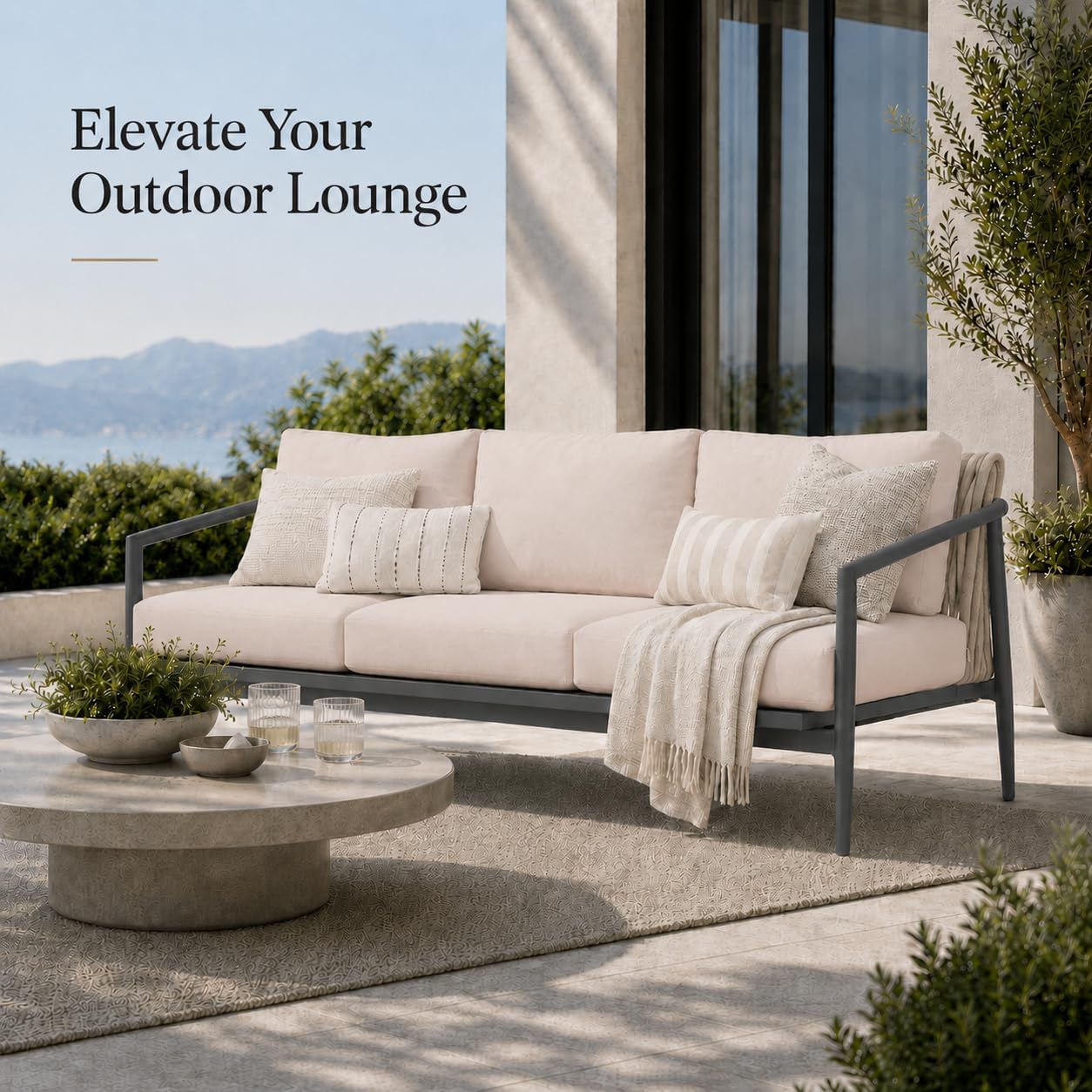
If you’re standing in a showroom—or scrolling a browser tab at midnight—looking at aluminum sectional sofa sets and wondering why the price range runs from $800 to $18,000 for what appears to be roughly the same shape of outdoor couch, this guide is going to answer that question in plain terms. An aluminum sectional is an outdoor modular sofa whose frame is built from aluminum tubing or cast aluminum, designed to live outside year-round. The modular part matters: individual corner pieces, armless seats, and ottomans clip or bolt together in configurations you can rearrange as your space evolves. What separates a set that looks tired in three seasons from one that holds its finish and structure for fifteen years comes down to three things: frame gauge (how thick the aluminum walls are), powder-coat finish (the baked-on color layer that protects against rust, UV, and salt air), and cushion fabric warranty (what the manufacturer actually promises to cover and for how long). This article breaks all three down, shows you where the spec sheets diverge from reality, and ends with a decision rule you can apply to whichever deal is currently on your desk.
| EDITOR'S PICK[LayinSun Oversized Aluminum Out…](https://www.amazon.com/dp/B0CY273N61?tag=greenflower20-20) | Mid-tier[UDPATIO Aluminum Patio Furnitur…](https://www.amazon.com/dp/B0GQ5DJRQB?tag=greenflower20-20) | Budget pick[LayinSun Outdoor Aluminum Furni…](https://www.amazon.com/dp/B0FHQNFFNW?tag=greenflower20-20) | |
|---|---|---|---|
| Cushion Thickness | 6" | 6" | — |
| Seating Depth | Deep seating | — | — |
| Style | Oversized | Faux Wood Grain | Modern |
| Price | $1,829.99 | $1,249.99 | $849.99 |
| See on Amazon → | See on Amazon → | See on Amazon → |
Frame Gauge: Why Wall Thickness Is the First Number to Find
Gauge in aluminum tubing refers to the wall thickness of the hollow tube that forms the frame. A thicker wall means a heavier, more rigid frame that resists flex, racking (the diagonal wobble you feel when you sit at an angle), and dent damage over time. Here’s where the market splits:
Entry tier ($400–$1,200): Most mass-market sectionals in this range use 1.2mm to 1.5mm wall thickness. The frames are technically aluminum, so they won’t rust, but owners consistently report flex in the seat rail after two or three seasons of regular use—especially in larger L- or U-shaped configurations where the spans are longer. This Old House’s overview of outdoor furniture construction notes that thin-wall frames under 1.5mm are adequate for occasional-use pieces but show fatigue faster under daily load.
Mid-tier ($1,500–$5,000): Brands like Telescope Casual and Polywood’s aluminum-frame lines typically publish specs at 1.6mm to 2.0mm wall thickness. The difference is measurable in frame stiffness. At this gauge, a properly welded joint handles the repetitive stress of people sitting down hard without working loose. Reviewers across aggregated feedback for this segment note that the frame itself rarely fails—issues at this tier tend to migrate to the hardware (bolts, connection brackets) before the tube itself.
Premium tier ($5,000–$20,000+): Marine-grade or aircraft-grade 6061 aluminum alloy at 2.0mm to 3.0mm wall thickness is standard in Gloster, Brown Jordan, and Janus et Cie collections. At this spec, the frame carries a structural lifetime warranty from most of these manufacturers because the failure rate is low enough to make the warranty economically viable. Architectural Digest’s material durability ranking consistently places properly gauged marine-grade aluminum above wrought iron, standard steel, and even FSC teak on a twenty-year maintenance-cost basis, citing corrosion resistance as the differentiating factor.
The question to ask any sales rep or spec sheet: “What is the wall thickness of the main seat and back rails in millimeters, and what aluminum alloy series is the frame?” If the answer is vague, treat that as a yellow flag.
Cast vs. Extruded Aluminum: A Quick Distinction
Extruded aluminum (tubing) is what most sectionals use for straight runs. Cast aluminum—poured into molds—appears in decorative feet, armrest caps, and occasionally full chair frames in transitional-style collections. Cast pieces are heavier and more ornate, but they can be more brittle under impact than extruded tube. For a permanent outdoor sectional, extruded tube for the structural frame and cast details for accents is the most common and sensible construction.
Powder-Coat Finish: What the Warranty Actually Covers (and What It Doesn’t)
Powder coating is a dry finishing process in which electrostatically charged powder is applied to the aluminum frame, then cured in an oven at roughly 400°F. The result is a hard, uniform color layer that bonds to the metal. It is more durable than liquid paint for outdoor use. But not all powder coats are equal, and the warranty language is where most buyers get surprised.
Film thickness matters. Spec sheets from quality manufacturers target 2–4 mils (thousandths of an inch) of dry film thickness. Below 2 mils, the coating is thin enough that UV exposure, abrasion from cushion movement, and the expansion-contraction cycle of outdoor temperature swings cause micro-cracking within a few years. House Beautiful’s buyer guide for outdoor furniture notes that the first visible sign is chalking—a powdery surface residue—before the coating begins to chip.
What “finish warranty” usually covers: Manufacturer warranties on powder-coat finish at the mid-to-premium tier typically cover peeling, blistering, and excessive chalking under normal outdoor conditions. The typical term is 3–5 years at the mid-tier, and 10–15 years (or lifetime) at the premium tier.
What it almost never covers:
- Scratches from dragging the frame across a deck surface
- Chipping from impact (dropped tools, patio furniture stacked incorrectly)
- Fading caused by pool chemicals, salt spray, or pressure washing with the wrong tip
- Finish failure on frames stored in direct contact with standing water
Good Housekeeping’s analysis of outdoor sectional warranties flags the salt-air carve-out as the most common surprise for coastal buyers. Brands like Brown Jordan and Gloster offer specific coastal-rated finish options—typically a dual-coat or PVDF-blended top coat—that extend the corrosion resistance in marine environments. If your project is within a mile of salt water, ask explicitly whether the finish is coastal-rated and what that adds to the warranty coverage.
By the Numbers: Frame and Finish Specs Across Tiers
| Tier | Typical Wall Gauge | Alloy Series | Powder Coat Warranty | Price Range (per set) |
|---|---|---|---|---|
| Entry | 1.2–1.5mm | 6063 | None or 1 year | $400–$1,200 |
| Mid | 1.6–2.0mm | 6061–6063 | 3–5 years | $1,500–$5,000 |
| Premium | 2.0–3.0mm | 6061 marine | 10–15 years / lifetime | $5,000–$20,000+ |
Cushion Fabric: Sunbrella Grades, Fill Density, and What the Label Doesn’t Tell You
The frame gets the buyer’s attention; the cushion is what actually determines whether you’re comfortable and whether you’re still happy with the set in year four. There are two variables that matter most: the fabric itself and what’s inside it.
Fabric: Sunbrella and Its Competitors
Sunbrella is the dominant brand in solution-dyed acrylic outdoor fabric, and for good reason. The dyeing process saturates color into the fiber before weaving, so UV exposure doesn’t strip the color from a surface coating—it would have to degrade the fiber itself. Apartment Therapy’s breakdown of outdoor fabric grades notes that solution-dyed acrylic from Sunbrella is rated for 2,000 hours of UV exposure (per manufacturer testing) before significant color shift, compared to 400–600 hours for polyester blends common in entry-tier cushions.
The grade distinctions within Sunbrella:
- Sunbrella Elements is the baseline collection used in most mid-tier outdoor furniture. It’s fade-resistant, water-repellent, and mold/mildew resistant.
- Sunbrella Marine and Sunbrella Elements Plus are heavier weaves (typically 9–10 oz/yd²) designed for constant moisture exposure. Some premium brands spec this for sectionals in high-humidity or coastal settings.
- Sunbrella Shift and newer performance collections add stain-release treatments—important distinction: fade-resistance and stain-resistance are not the same thing. A fabric can be excellent at holding color and still require prompt cleaning for red wine, sunscreen, or cooking oils.
Competitors worth evaluating: Outdura (made by Culp Industries) and Recacril (a Spanish solution-dyed acrylic popular in European brands like Gloster) perform comparably to Sunbrella in published UV-resistance specs. The real competitive moat Sunbrella holds is retail recognition and replacement availability—if you need to reorder a cushion cover in year six, Sunbrella’s distribution network makes it more likely the pattern is still accessible.
Cushion Fill: Density Is the Deciding Number
The fill inside the cushion is where manufacturers at every tier cut costs invisibly. The standard to ask about is foam density, measured in pounds per cubic foot (PCF):
- Below 1.5 PCF: Will compress and lose shape within a season or two of regular use. Common in entry-tier sets.
- 1.8–2.0 PCF: The minimum for a permanent outdoor room that sees daily use. This range holds shape through multiple seasons with proper storage or covers.
- 2.2–2.5 PCF: Standard in premium lines. Some use a quick-dry foam core (open-cell structure that drains water within hours of rain) wrapped in a fiber layer for comfort.
House Beautiful’s buyer guidance recommends asking specifically whether the foam core is closed-cell (water-resistant but slow to dry if submerged) or open-cell quick-dry (preferred for climates with frequent afternoon rain). Brown Jordan and Gloster both spec quick-dry foam as standard in their sectional collections. At Polywood’s aluminum-frame tier, it’s optional depending on the collection.
The If-Then Decision Framework
You’ve evaluated the spec sheet. Here’s how to translate what you found into a go/no-go:
If the wall gauge is under 1.5mm: Acceptable for a secondary space or vacation rental that sees moderate use. Build in a replacement budget at year three to five. Do not specify for a permanent primary outdoor room or a high-traffic hospitality application.
If the powder-coat warranty is shorter than the brand’s structural warranty by more than 5 years: The manufacturer is signaling lower confidence in the finish than the frame. Either upgrade to the coastal-rated finish option, or plan to budget for professional refinishing around year five.
If the cushion fabric is unlabeled or “polyester blend” and the foam density is unspecified: Walk away from this tier for a permanent installation. Entry-tier cushions in outdoor sectionals are consumables, not durable goods.
If frame gauge is 2.0mm+, finish is powder-coat with a 10-year-plus warranty, fabric is solution-dyed acrylic at 9oz or better, and foam density is 1.8 PCF or higher: You have the spec profile of a set that should perform for 12–20 years in most climates with basic maintenance. The delta between the $4,000 set and the $12,000 set at this spec level is primarily aesthetic resolution, brand warranty service infrastructure, and finish customization options—not functional longevity.
For coastal installations specifically: Require explicit coastal-rated finish documentation before specifying any set within 1 mile of salt water, regardless of tier. The frame warranty is functionally meaningless if the finish fails first and allows salt-accelerated oxidation at weld points.
The aluminum sectional category rewards buyers who read past the marketing copy and into the spec sheet. The numbers are there—wall gauge, alloy series, coating thickness, foam density, fabric construction—and once you know what you’re looking for, the price differences stop feeling arbitrary and start making sense. The $12,000 Brown Jordan sectional isn’t ten times the sofa the $1,200 entry-tier set is, but it likely carries three times the structural lifespan with a fraction of the maintenance cost. For a permanent outdoor room, that math usually closes in favor of the upgrade within five to seven years.