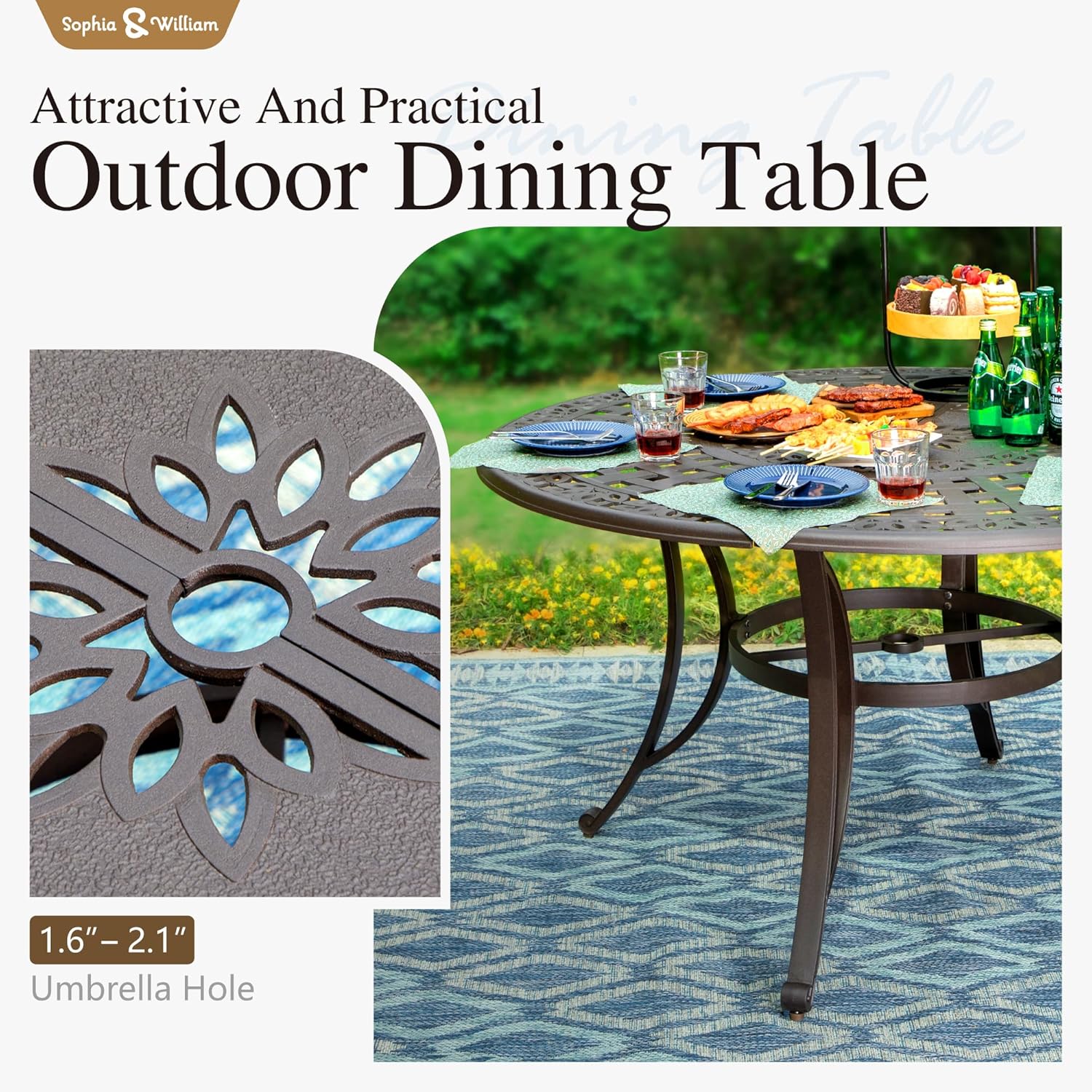
Cast aluminum patio dining chairs are exactly what the name says: chairs built from aluminum that has been melted down and poured (cast) into a mold, rather than bent from flat sheet or extruded through a die. The result is a thicker, denser frame capable of holding fine surface detail — the ornate scrollwork on a traditional garden chair, or the clean radiused edges on a contemporary piece. For anyone furnishing an outdoor dining area, the appeal is obvious: aluminum doesn’t rust, it’s light enough to rearrange without straining your back, and a well-made piece can outlast two or three cheaper alternatives. But here’s the thing most buyers don’t discover until it’s too late — the gap between a $120 cast aluminum chair and a $380 one often has nothing to do with how the chair looks when it arrives. It has everything to do with how the frame was assembled and how the paint was applied. This guide breaks down exactly what to look at so your purchase holds up whether you’re outfitting a single deck or restocking six units for a rental property.
| EDITOR'S PICKSophia & William 7 Pieces Cast… | Mid-tier[HAPPATIO Aluminum 9 Piece Patio…](https://www.amazon.com/dp/B0BRKVLVSM?tag=greenflower20-20) | Budget pick[VINGLI 5 Pieces Outdoor Patio D…](https://www.amazon.com/dp/B0DHS8J1NJ?tag=greenflower20-20) | |
|---|---|---|---|
| Material | Cast Aluminium | Aluminum | Cast Aluminium |
| Pieces | 7 | 9 | 5 |
| Seating | 6 | 8 | 4 |
| Finish | Powder-Coating | — | — |
| Umbrella Hole | 2.2" | — | — |
| Price | $1,399.99 | $1,299.99 | $398.99 |
| See on Amazon → | See on Amazon → | See on Amazon → |
Cast vs. Extruded vs. Tubular Aluminum: Why the Distinction Matters at Your Price Point
Before evaluating finish quality, you need to confirm you’re actually buying cast aluminum rather than a lookalike. The three most common aluminum constructions in outdoor furniture are frequently lumped together in marketing copy, and confusing them leads to mismatched expectations on durability and repairability.
Cast aluminum is poured molten into sand or die molds and then machined. Walls are typically 3–5mm thick on quality frames, which gives them substantial heft and the ability to hold sharp ornamental detail without sacrificing strength. The Aluminum Association’s material guides note that cast components handle compressive loads well, making them particularly suited to legs and armrests that absorb the full weight of a seated person plus dynamic load (someone leaning back, pushing up from the table).
Extruded aluminum is pushed through a shaped die like toothpaste from a tube, producing consistent hollow profiles — think rectangular or round tubing. This is perfectly durable for structural members, and brands like Gloster and Janus et Cie use it extensively in their premium contemporary collections because it produces very clean, linear geometry. The weakness: complex curves and decorative castings require welding separate extruded pieces together, which creates joints that must be inspected carefully.
Tubular aluminum (often called “aluminum tube” in entry-level listings) refers to lighter-gauge hollow stock bent into chair frames. Walls can be as thin as 1.2–1.8mm. This isn’t inherently problematic for light-duty use, but it’s a different product category from cast aluminum and shouldn’t command the same price or durability expectations.
The practical test: Lift the chair. A genuine cast aluminum dining chair in the 18–24 inch seat-height range should weigh 12–18 lbs. Chairs marketed as cast aluminum but weighing under 9 lbs almost certainly use thin-wall tubular construction or partial casting. Good Housekeeping’s outdoor furniture materials guide flags weight as the simplest proxy for wall thickness when spec sheets aren’t available.
Powder-Coat Cure: The Detail That Determines Whether Your Finish Lasts Three Years or Fifteen
Powder coating is the process of electrostatically applying dry paint particles to the aluminum frame and then baking them in an oven to form a hard, continuous film. Done correctly, it outperforms liquid paint on every relevant metric: adhesion, UV resistance, chip resistance, and the ability to flex slightly with the metal underneath as temperatures cycle. Done incorrectly, it fails within two to three seasons — fading, chalking, or peeling at weld points and edges.
The cure stage is where most quality divergence happens, and it’s invisible to the buyer at purchase. Two variables dominate:
Cure temperature and dwell time. Most polyester powder coats designed for outdoor furniture cure optimally between 375°F and 400°F (190–204°C) with a dwell time of 15–20 minutes at temperature. Undercuring — either too low a temperature or too short a dwell — leaves cross-linking incomplete. The coating looks fine initially but is more porous at a microscopic level, which means UV radiation and moisture penetrate faster. Overcuring causes the film to become brittle and crack earlier under thermal cycling.
Film thickness. Industry guidelines, including those published by the American Architectural Manufacturers Association (AAMA) in their AAMA 2604 and 2605 voluntary specifications, establish minimum dry film thickness for architectural and high-performance coatings at 2–3 mils (thousandths of an inch). Better outdoor furniture manufacturers target 3–4 mils on structural members. Budget producers running high-volume lines often apply thinner coats to reduce powder consumption, which shows up as edge coverage failure — the thinly coated edges of a weld or casting are almost always the first place a substandard finish deteriorates.
What to ask before you buy:
- Does the manufacturer publish their powder-coat specification? Any serious brand (Brown Jordan, Telescope Casual, Homecrest) should be able to tell you their film thickness target and cure schedule.
- Does the warranty cover finish failure specifically, or only frame failure? A “lifetime frame warranty” that excludes finish is common in the $150–$300 chair tier. Architectural Digest’s guide to outdoor furniture longevity notes that finish warranty terms are one of the clearest sorting mechanisms between commodity and investment-grade outdoor furniture.
- Is the frame pre-treated before powder coating? Quality processes include cleaning, chemical etching or phosphate conversion coating, and a primer layer. Skipping pre-treatment is one of the fastest ways to produce a powder coat that lifts cleanly at the aluminum interface after a few freeze-thaw cycles.
By the Numbers: What Finish Warranty Terms Actually Signal
| Warranty tier | Typical frame coverage | Finish coverage | Who offers it |
|---|---|---|---|
| Entry-level | 1–2 years, frame only | None or 90 days | Hampton Bay, some Christopher Knight |
| Mid-tier | 3–5 years frame | 1–2 years finish | Telescope Casual, Homecrest, Woodard |
| Premium | 10–15 years or lifetime, frame | 3–5 years finish | Brown Jordan, Gloster, Janus et Cie |
The finish warranty gap between entry and premium is not cosmetic — it’s a proxy for the manufacturer’s confidence in their cure process and the alloy they’re using. A five-year finish warranty signals that the manufacturer has modeled real-world weathering data and is willing to back that spec financially.
Alloy Grade and Joint Construction: The Hidden Variables in Frame Longevity
Most outdoor furniture aluminum uses alloys in the 6000 series (primarily 6061 or 6063), which balance good corrosion resistance, reasonable strength, and castability. The Aluminum Association’s published technical data puts 6061-T6 tensile strength at approximately 45,000 psi, which is more than adequate for chair frames. Budget pieces sometimes use lower-purity secondary aluminum — recycled scrap with higher silicon and iron contamination — which can affect surface finish adhesion and long-term corrosion resistance in coastal environments.
For buyers in coastal or high-humidity climates, joint construction is as important as alloy choice. Cast aluminum chairs can be assembled three ways:
One-piece casting: The entire chair shell (or a major section like the seat-back assembly) comes out of the mold as a single piece. No joints to fail. This is the gold standard and is common in premium ornate designs because the mold cost is only worth it at volume or high margin.
Bolted assembly: Individual cast components — legs, seat frame, back rails — are joined with stainless steel hardware. Durable when done with quality fasteners and anti-corrosion compound at the joint, but the bolts themselves are the maintenance point. Operators in multi-unit hospitality settings should verify hardware grade; standard carbon steel bolts are a recurring failure point in otherwise solid aluminum chairs.
Welded assembly: Common on contemporary pieces using extruded members with cast connectors. Weld quality varies enormously. Sunset Magazine’s outdoor furniture guide recommends inspecting welds in person when possible — a good weld is smooth and continuous; a cold weld or tack weld used in production cost-cutting will show as a rough, irregular bead that powder coat can’t fully hide.
Matching Construction Quality to Your Use Case: The Decision Framework
If you’re reading this, you’re likely evaluating a pending purchase, not browsing abstractly. Here’s the if/then logic based on what the research consistently supports:
If you’re furnishing a primary outdoor dining space and expect the chairs to serve 10+ years without recoating or replacement: Prioritize a documented powder-coat spec (minimum 3 mils, full cure certification), a finish warranty of at least three years, and stainless or marine-grade hardware at all joints. Brown Jordan’s published warranty documentation and Telescope Casual’s specification sheets are models for what a credible manufacturer discloses. Budget: plan on $250–$500 per chair from a brand with verifiable specs. This Old House’s review of outdoor dining sets consistently finds that chairs in this range, from brands with multi-year finish warranties, show meaningfully less degradation at five-year marks than sub-$150 options.
If you’re a property manager or vacation-rental operator outfitting multiple spaces: Stackability and finish durability at the edge (where chairs contact each other during stacking) become critical selection criteria. Look for chairs with powder-coat edge coverage ratings or brands that offer bumper protection pads. Restoration Hardware Outdoor and Telescope Casual both offer commercial-grade cast aluminum lines with stackability designed in from the frame geometry, not retrofitted. Factor finish touch-up into your maintenance budget regardless — plan one full refinish per chair over a seven-year service cycle, typically $40–$80 per chair at a local powder-coat shop.
If you’re at the starter tier ($100–$200 per chair) with a defined replacement horizon: Be realistic that you’re buying a 4–6 year product under normal use. Prioritize chairs with bolted rather than welded construction because bolted frames can be disassembled if a component fails — you may replace one leg rather than the entire chair. Hampton Bay and Christopher Knight Home both offer cast-look aluminum chairs in this range where owners in aggregated reviews consistently note the finish shows UV weathering by year three in sun-heavy climates; budget for a furniture cover or plan to store cushions seasonally.
If your site is coastal (salt air, persistent humidity): Add one requirement regardless of budget tier: ask specifically about the pre-treatment process before powder coating. A phosphate conversion coat or chromate primer dramatically slows under-film corrosion at pores and scratch points. Brands that advertise “marine-grade” finishing are specifically referencing this pre-treatment. Sunset Magazine’s coastal outdoor furniture guidance notes that in oceanfront conditions, pre-treatment quality often matters more than alloy grade for five-year finish survival.
The Bottom Line
Cast aluminum’s reputation for durability is well-earned — but that reputation was built on chairs made to a standard that not every product in the category meets. Price per chair is a loose proxy for quality; frame weight, finish warranty language, and the manufacturer’s willingness to document their cure specification are the real signals. An $80 savings per chair across an eight-chair table setting is $640 upfront — and potentially $1,200–$2,000 in earlier replacement costs if the finish fails and the frames corrode at the joints. The math consistently favors spending to the point where a manufacturer will put a multi-year finish warranty in writing. Below that threshold, you’re buying on hope. Above it, you’re buying on evidence.