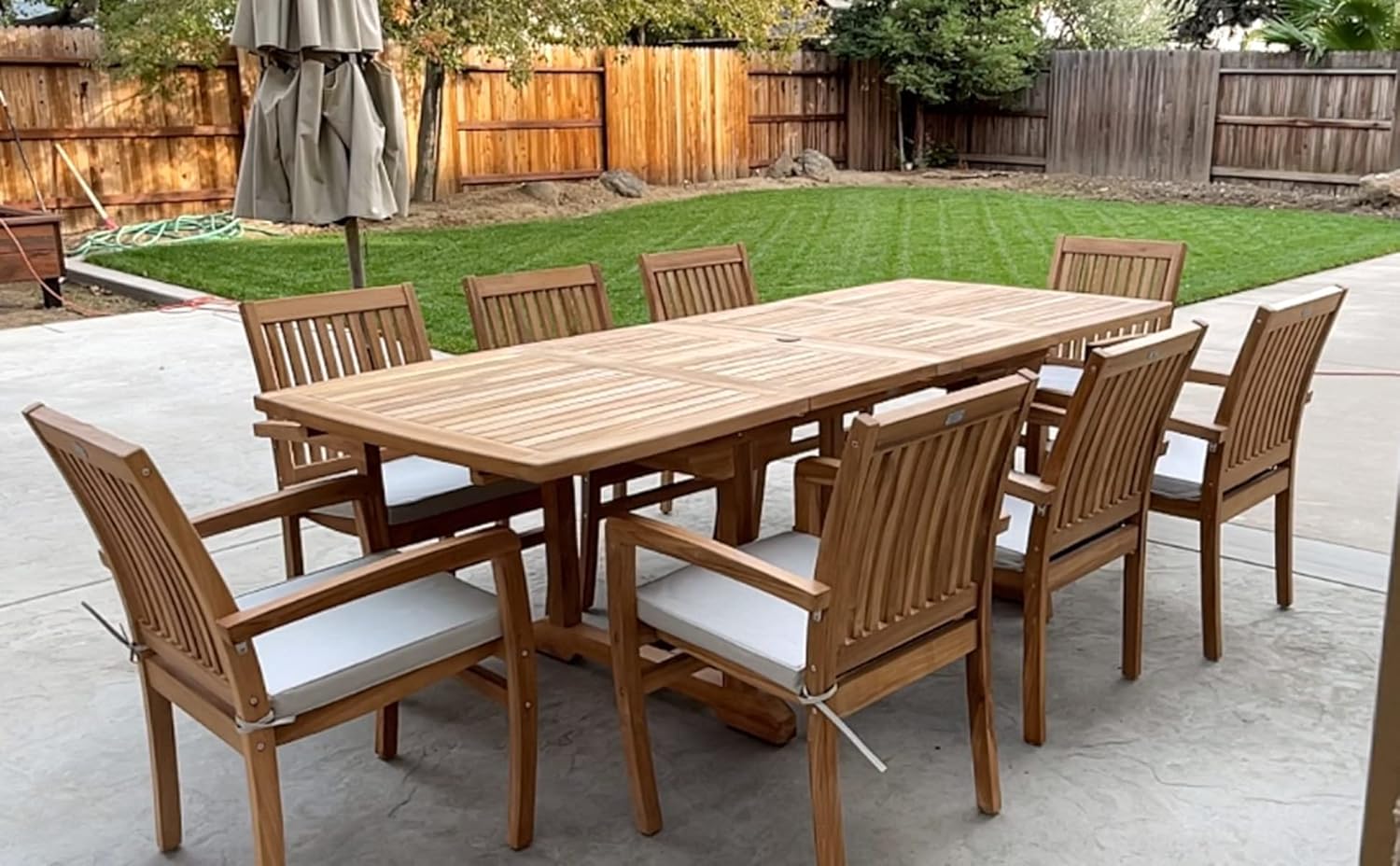
If you’ve ever wondered why one teak dining set costs $1,200 and another — visually similar at the showroom — runs $6,000, the answer almost always lives inside the wood itself. Teak (Tectona grandis) is a tropical hardwood prized for outdoor furniture because it naturally produces oils and a dense grain structure that resist rot, moisture, and insects without constant sealing. But “teak” on a hang tag doesn’t tell you which part of the tree the wood came from — and that distinction, captured in the grading system (Grade A, B, or C), is the single biggest predictor of how your frame will look and perform ten or twenty years from now. This guide walks through what each grade actually means, how to verify what you’re buying, and the honest math on where the premium pays off.
What Teak Grades Actually Measure — and Where the System Comes From
Teak grading is a trade classification, not a government-regulated standard. That matters because no single body enforces it globally. The grades describe where in the log the lumber originates, which directly determines oil content, grain tightness, and color consistency.
Grade A is cut from the heartwood — the dense, dark, innermost section of a mature teak log. The Food and Agriculture Organization of the United Nations, in its silviculture profile of Tectona grandis, notes that heartwood teak contains the highest concentration of tectoquinone and other natural oils that give the species its weather resistance. Grade A lumber shows tight, straight grain, minimal knots, and a uniform golden-brown color. This is the part of the tree that has spent decades accumulating the resinous compounds that make teak worth the price premium in the first place.
Grade B is cut from the transition zone between heartwood and sapwood. Oil content is lower, grain is less uniform, and color variation is more pronounced. Furniture built from Grade B teak will weather faster, may show surface checking (small surface cracks as the wood dries) sooner, and typically requires more frequent oiling to maintain its appearance.
Grade C draws from the outer sapwood — young, pale, and oil-poor. It’s still technically teak, but it behaves more like a generic hardwood outdoors. It grays quickly, is more susceptible to moisture infiltration at joints, and will not age gracefully in the way that makes teak worth the investment.
The practical implication: when a brand markets a set as “solid teak” without specifying the grade, the default assumption should be Grade B or a mix. Reputable premium manufacturers — Gloster, Brown Jordan’s teak collections, and Barlow Tyrie — specify Grade A heartwood explicitly in their product documentation and back it with warranty terms that reflect it.
The Longevity Math: What Grade A Actually Buys Over Time
Here’s where the practitioner decision frame becomes useful. Let’s run the numbers on a representative comparison:
By the numbers
| Grade | Typical price range (6-pc dining set) | Expected structural lifespan (outdoor, unsealed) | Oil maintenance cycle |
|---|---|---|---|
| Grade A heartwood | $3,500 – $12,000 | 25–75 years | Every 1–2 years |
| Grade B transition | $1,500 – $3,500 | 10–20 years | Annually |
| Grade C sapwood | $600 – $1,500 | 5–10 years | Every 6 months |
These ranges are drawn from manufacturer published specifications, This Old House’s outdoor furniture materials guide, and Consumer Reports’ outdoor furniture buying guidance. The structural lifespan figure assumes normal outdoor exposure — meaning it sees rain and sun — in a temperate climate. Coastal or tropical environments compress those timelines for Grade B and C significantly.
The cost-per-year math shifts the Grade A premium considerably. A $6,000 Grade A set lasting 40 years runs $150 per year before maintenance. A $2,200 Grade B set replaced after 15 years runs roughly $147 per year — but you’re now managing a replacement project, new lead times (currently 12–20 weeks for premium teak brands as of mid-2026), disposal of the old furniture, and the aesthetic disruption of re-specifying. For a vacation rental host or property manager running multiple spaces, that replacement cycle compounds quickly.
The argument for Grade A is not just romance about the wood — it’s the elimination of replacement friction at scale.
How to Verify Grade Before You Buy
This is where buyers get burned most often. The word “teak” on a product listing carries no graded meaning unless the brand explicitly states Grade A heartwood. Here’s a practical verification checklist:
1. Ask for the species and grade in writing. The species should be Tectona grandis — not “plantation hardwood,” “Asian hardwood,” or a brand name that obscures the species. Grade A heartwood should be stated explicitly.
2. Check the FSC certification. The Forest Stewardship Council’s Forest Management Certification Standard is the primary chain-of-custody verification for legally and sustainably harvested teak. FSC-certified teak doesn’t automatically guarantee Grade A, but it does guarantee that the supply chain is documented — and brands making Grade A claims are far more likely to maintain FSC certification because the documentation discipline overlaps. Per Architectural Digest’s teak buyers guidance, FSC certification has become the baseline expectation among design-conscious buyers at the premium tier.
3. Examine the color and grain in person. Grade A heartwood is uniformly golden-brown to medium brown with tight, straight grain and essentially no knots. Grade B often shows blotchy color variation — lighter streaks from sapwood intrusion — and softer, more irregular grain patterns. Under finish, these differences are sometimes masked, which is one reason to request unfinished or natural-oil-finished samples when specifying at volume.
4. Read the warranty language carefully. A legitimate Grade A teak warranty covers the frame (structural integrity) for a meaningful period — Brown Jordan, for example, warrants teak frames against structural defects for the life of the original owner. Brands hedging on grade typically limit structural warranties to five or ten years, which is a tell. The Consumer Reports outdoor furniture buying guide specifically flags warranty duration as a proxy for manufacturer confidence in material quality.
5. Ask about kiln drying. Properly kiln-dried teak (brought to 8–12% moisture content before machining) is far less prone to surface checking and joint movement than air-dried or green lumber. This is a manufacturing process question, not just a grade question — but Grade A suppliers at the premium tier almost universally kiln-dry.
Where Grade A Pays Off Most — and Where It Doesn’t
Grade isn’t the only variable, and treating it as one leads to overspending in some situations and false economy in others.
Grade A pays its premium clearly when:
-
You’re furnishing a permanent outdoor living room attached to a high-value home where the furniture is part of the architectural composition. The long aging cycle of Grade A teak — it weathers to a consistent silver-gray if left unsealed, or holds its golden tone with periodic oiling — produces the visual coherence that matters here. Grade B’s uneven graying and surface checking undercut the aesthetic.
-
You’re a property manager or hospitality operator specifying furniture that has to last through heavy-use seasons without intervention. The lower maintenance frequency of Grade A (oiling every one to two years versus every six months for Grade C) matters when you’re managing twelve properties simultaneously.
-
You’re in a coastal, tropical, or high-humidity environment. The FAO’s documentation on Tectona grandis wood properties highlights that the natural oil content of heartwood is what confers its resistance to moisture-driven decay and marine organisms. Grade B and C lose this advantage faster in demanding climates.
Grade A is less clearly necessary when:
-
You’re furnishing a covered balcony or screened porch where the furniture has meaningful protection from direct weather exposure. In low-stress environments, Grade B can deliver 15–20 good years, and the cost difference may fund better cushions, a shade structure, or a second seating area.
-
You’re outfitting a short-term rental where the furniture will be replaced every eight to ten years anyway as part of a refresh cycle and the per-set budget is constrained. Grade B teak from a reliable supplier (Telescope Casual sources solid teak for several lines; their documentation specifies grade on request) can be a rational choice here.
-
You’re a first-time buyer testing whether an outdoor dining setup works for your lifestyle before committing to a full permanent installation. Starting with a quality Grade B set and upgrading in five years as you define your actual use patterns is a legitimate sequencing strategy.
The Finish Question: Oiled, Sealed, or Left to Gray
Grade interacts with finish choice in ways that aren’t always obvious. Grade A heartwood has enough natural oil content that it can be left completely untreated outdoors and will weather to a stable silver-gray over 12–18 months — a finish many designers specify intentionally for its relationship to weathered stone and aged zinc. Per Architectural Digest’s teak guidance, this “silver patina” is considered a feature, not deterioration, when the underlying wood is Grade A heartwood. Grade B left untreated produces an uneven, blotchy gray that reads as neglect rather than design intent.
If you want to maintain the golden-brown tone, teak oil or a purpose-formulated teak sealer applied annually (Grade A) or twice yearly (Grade B) achieves it. Avoid film-forming finishes like varnish or polyurethane on outdoor teak — they trap moisture under the film as the wood moves seasonally, leading to peeling and surface damage. This Old House’s outdoor furniture materials guide reinforces this point: teak’s natural movement demands penetrating finishes, not surface films.
The Decision Rule
If you’re sitting with a purchase decision right now, here’s the clean if/then framework:
If the furniture is going into a permanent, high-visibility outdoor space — especially coastal, tropical, or architecturally integrated — and you’re planning to own it for 15+ years, then Grade A heartwood from an FSC-certified supplier with a structural warranty of 10 years or longer is the correct specification. The premium is real, but the cost-per-year math and the maintenance reduction justify it decisively.
If you’re outfitting a transitional space, a covered or semi-protected area, or a rental property where replacement cycles are already planned, then Grade B teak from a reputable brand with documented species and grade is a reasonable middle path — provided you budget for more frequent maintenance and a shorter replacement horizon.
If a listing says “solid teak” without specifying grade, treat it as Grade B until verified otherwise. Ask directly. A brand confident in its material will answer without hesitation.
The grade stamped on a frame — or more often, quietly omitted — is one of the highest-leverage variables in the outdoor furniture decision. Knowing what it means, how to verify it, and where it matters most puts you in a position to spend money where it actually buys longevity rather than where it only buys the appearance of it.