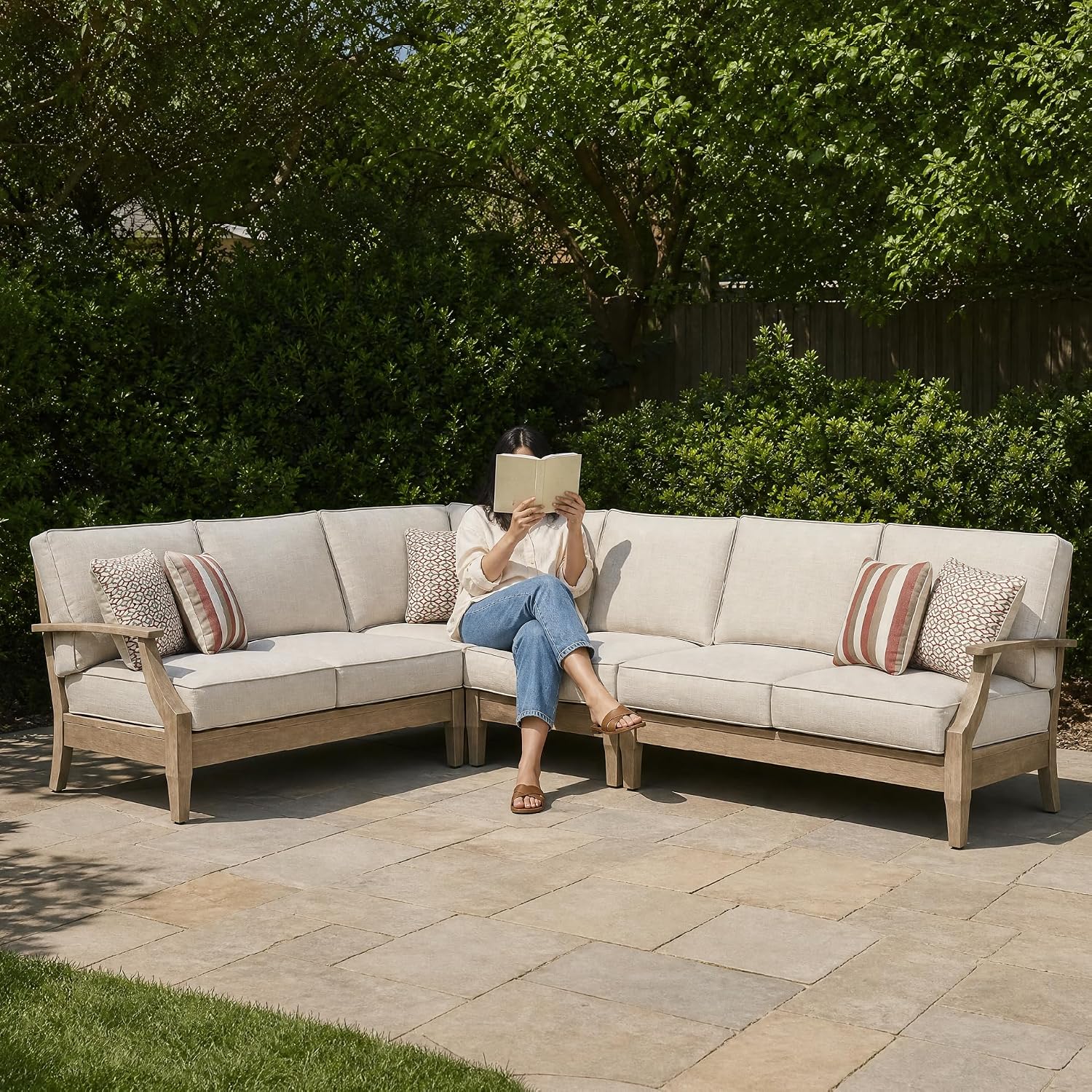
Walk into any outdoor furniture showroom right now and you’ll see three materials wearing the same “all-weather” label — HDPE lumber, PE wicker, and resin rattan — at price points that span $400 to $4,000+ for a sectional alone. HDPE (high-density polyethylene) lumber is the rigid, wood-look material you’ve seen on Adirondack chairs and deep-seat frames; it’s a solid plastic plank made from recycled milk jugs and similar post-consumer plastics. PE wicker is a thin, flexible strand of polyethylene resin wrapped in a tight weave over a metal or aluminum frame — it mimics the look of natural wicker without the rot risk. Resin rattan is often used interchangeably with PE wicker in marketing copy, but it typically signals a slightly thicker, rounder strand profile meant to evoke the chunky look of tropical rattan. All three are synthetic, all three are theoretically water-resistant, and all three will fade on you if you buy the wrong grade. This guide cuts through the shared marketing language and shows you exactly where each material holds up, where it doesn’t, and how to read the warranty fine print that will matter most in year three, four, and five.
| EDITOR'S PICKSignature Design by Ashley Broo… | Mid-tier[HDPE Outdoor Patio Furniture Set](https://www.amazon.com/dp/B0GK8WLZRT?tag=greenflower20-20) | Budget pick[JOYURE 7 Piece Wicker Patio Fur…](https://www.amazon.com/dp/B0CW2QBCLJ?tag=greenflower20-20) | |
|---|---|---|---|
| Material | Resin wicker | HDPE | Wicker |
| Frame | Aluminum | — | — |
| Pieces | — | 10 | 7 |
| Cushions | High-performance | — | Thick, anti-slip |
| Table included | — | ✓ | ✓ |
| Price | $1,796.97 | $1,117.99 | $539.00 |
| See on Amazon → | See on Amazon → | See on Amazon → |
What “All-Weather” Actually Means — and What It Doesn’t
“All-weather” is a marketing claim with no universal industry standard behind it. No independent certifying body defines the term for residential outdoor furniture the way, say, ASTM International defines weathering resistance for industrial coatings. That matters because two sectionals can both carry the “all-weather” badge — one rated to UV index 9 and tested for 3,000 hours of accelerated weathering, the other printed with marketing language that means nothing verifiable.
What manufacturers can be held to is the specific language in their written warranty. That’s your real benchmark.
HDPE lumber: The most durable of the three in structural terms. Polywood’s published material guide describes their HDPE as manufactured with UV-stabilized pigment dispersed throughout the plank — not a surface coating — which means a scratch or nick doesn’t expose unpigmented material underneath. The practical implication: HDPE doesn’t need sealing, painting, or annual treatment. It won’t splinter, crack from freeze-thaw cycles, or absorb moisture. Polywood backs this with a 20-year limited residential warranty on the lumber itself, which This Old House’s buyer’s guide notes is among the strongest structural guarantees in the outdoor furniture category.
The tradeoff is purely aesthetic: HDPE’s rigid plank format is better suited to dining chairs, benches, and Adirondack-style seating than to the plush, deep-seat sectional look. You’ll find HDPE used most on frames and as structural slats in sectionals, with cushions doing the comfort work.
PE wicker: This is where most all-weather sectionals in the $800–$3,500 range live. PE wicker is woven over a frame — almost always powder-coated aluminum or steel — and the durability story is actually two separate stories: the weave and the frame underneath it.
Good PE wicker (look for “commercial-grade” or “marine-grade” designations in the spec sheet) uses round-strand or flat-strand polyethylene with UV inhibitors blended into the extrusion. Per Good Housekeeping’s outdoor furniture review methodology, higher-quality PE wicker maintains color and structural integrity through five or more seasons in full-sun environments. Lower-grade wicker — often found in the sub-$600 bracket — uses a thinner strand with surface-applied color that chalks and fades measurably by season two in high-UV climates.
The frame underneath matters just as much. Steel frames corrode at any raw edge over time; powder-coated aluminum frames are the industry standard for longevity. Bob Vila’s 2025 sectional buying guide flags frame corrosion as the leading cause of PE wicker sectional failure — not the weave itself.
Resin rattan: In practice, most “resin rattan” sold in the $400–$1,200 range is PE wicker with a chunkier strand profile, marketed to capture the aesthetic of natural rattan. Apartment Therapy’s breakdown of the wicker vs. HDPE category confirms that “resin rattan” is not a distinct material category — it’s a styling convention. When you’re evaluating a resin rattan sectional, apply the same framework as PE wicker: check the strand thickness, UV inhibitor specification (if disclosed), and frame material. The aesthetic upside is real — the thicker strand creates more visual depth and a warmer, artisanal look that photographs well for vacation rental listings. The durability profile is identical to PE wicker of equivalent grade.
The Five-Season Test: Where Each Material Shows Its Age
If you’re buying for a primary residence and want furniture that looks presentable in year five without refinishing, here’s the honest breakdown based on published specs and aggregated owner reporting:
By the Numbers
| Material | Expected color stability (full sun) | Frame corrosion risk | Structural failure mode | Maintenance cycle |
|---|---|---|---|---|
| HDPE lumber | 10–20 years (pigment-through) | None (no metal frame) | Rare; UV chalking on inferior grades | Soap + water, 1x/year |
| PE wicker (alum. frame) | 5–10 years (commercial grade) | Low | Weave unraveling at stress points | Rinse 2x/year; inspect joints |
| Resin rattan (steel frame) | 3–6 years (consumer grade) | Moderate–High | Frame rust telegraphing through weave | Annual inspection; touch-up paint |
Ranges reflect grade variation; upper end assumes commercial-grade specification. Based on published manufacturer specs and This Old House material longevity data.
HDPE in year five: Owners consistently report minimal change in color saturation on Polywood and similar commercial-grade HDPE, even in Zone 10 climates (think South Florida or Southern California high-UV conditions). The most common complaint in long-run reviews is surface chalking on lower-priced HDPE from brands that don’t specify UV inhibitor content. If a manufacturer won’t state that UV stabilizers are blended throughout the material (not surface-applied), treat it as a yellow flag.
PE wicker in year five: The pattern across aggregated reviews is clear: good weave on a compromised frame. Operators in vacation-rental contexts report that aluminum-framed PE wicker sets with welded (not bolted) joints routinely reach five to seven seasons without structural issues. Sets built on steel frames with bolted connections show rust weeping through the weave at connection points by season three in coastal or high-humidity environments.
Resin rattan in year five: Consumer-grade resin rattan (the category that dominates the $400–$800 window) gets mixed reviews past three seasons. The wicker aesthetic holds reasonably well, but the underlying steel frames on most entry-level sets are the vulnerability. If you’re outfitting a short-term rental and rotating inventory on a three-year cycle anyway, this category delivers strong ROI. If you’re buying once and expecting eight years, you’re likely to be disappointed.
Reading the Warranty: What to Actually Look For
Warranty language is where the real conversation lives. Most buyers skim the headline number (“limited lifetime warranty!”) without reading what “limited” excludes. Here’s what to look for in each material category:
HDPE: A credible HDPE warranty covers the lumber against cracking, splintering, chipping, peeling, rotting, and structural defects for a defined period (20 years is the category benchmark, per Polywood’s published documentation). Watch for exclusions around “normal weathering” — this can be used to deny claims on chalking or surface oxidation. Ask specifically: does the warranty cover color fade, and to what delta-E threshold?
PE wicker: Look for separate coverage on (1) the weave and (2) the frame. Manufacturers who bundle them into one warranty term are often obscuring that frame coverage is shorter. A strong warranty explicitly covers the powder-coat finish against chipping and corrosion for at least five years. “Manufacturing defects only” language on the frame is a signal that they’re not confident in the corrosion resistance.
Cushions: Regardless of frame material, cushion warranties are almost always separate — and shorter. Sunbrella’s fabric warranty covers fade resistance for five years on Solution Dyed Acrylic fabrics, which is the category standard for high-performance outdoor cushions. The Sunbrella warranty documentation is explicit that this covers the fabric, not the fill. Cushion fill (foam density, drainage design) is typically warranted for one to three years. Budget-grade polyester fill on even a well-built frame will compress and trap moisture within two seasons in wet climates — this is the most common comfort complaint in long-run owner reviews, separate from frame durability entirely.
The Decision Framework: If X, Then Y
You’re likely reading this with a specific context in mind. Here’s the honest filter:
If you’re furnishing a primary residence in a high-UV or coastal climate and want to buy once: Commercial-grade PE wicker on a fully welded, powder-coated aluminum frame is your best value-per-decade option in the sectional category. Budget $1,800–$3,500 for a quality four-to-five piece set. Verify the frame spec before purchasing — “aluminum frame” without a powder-coat and weld specification is insufficient information. HDPE lumber sectionals exist but are less common; if you find one, it’s likely your most durable option structurally.
If you’re outfitting multiple vacation-rental units on a three-to-four year replacement cycle: Resin rattan / consumer-grade PE wicker in the $600–$1,200 range makes economic sense. You’re not paying for decade-long durability you won’t use. Prioritize stackability, consistent availability for reorder, and Sunbrella or equivalent cushion fabric (the cushion is what guests touch — it drives reviews more than the frame in this context).
If you’re on a starter budget and furnishing a balcony or covered patio: Entry-level PE wicker in the $400–$700 range is defensible if the set lives under a covered structure and you’re in a temperate climate. In a full-sun, coastal, or freeze-thaw environment, the price difference between a $650 steel-frame set and a $1,100 aluminum-frame set pays back in season three when you’re not replacing the cheaper one.
If aesthetic longevity matters to you as much as structural longevity: HDPE’s pigment-through technology means the color you buy in 2026 is essentially the color you’ll have in 2034 on a commercial-grade product. PE wicker fades more visibly over time even on quality grades — that’s not a dealbreaker, but it’s worth factoring in if you’re designing to a specific palette.
The “all-weather” label is a starting point, not a destination. Match the material grade to your climate, verify the frame spec, read the warranty as a contract (not a tagline), and you’ll have the information the marketing copy was designed to obscure.