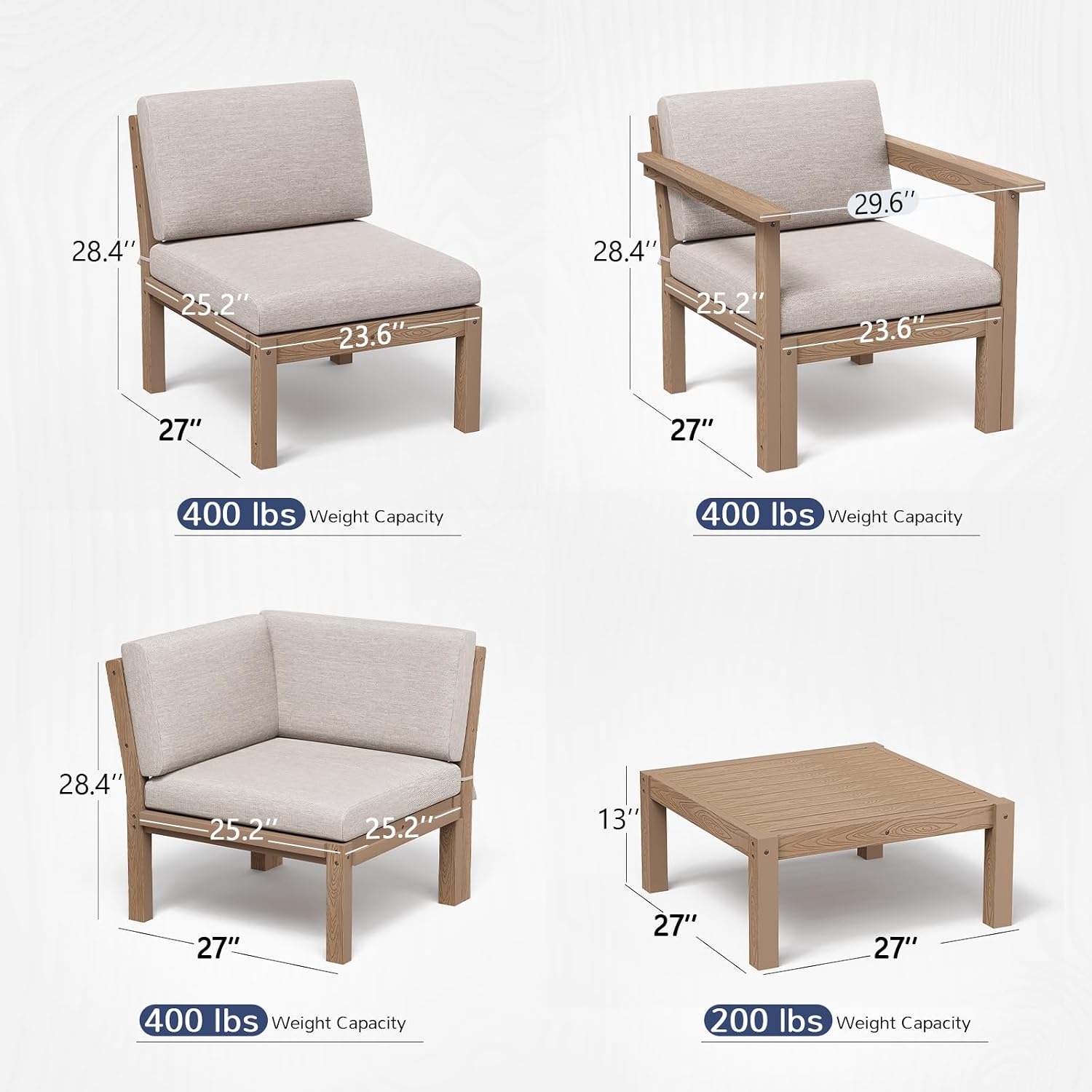
A modular outdoor sectional is exactly what it sounds like: a seating system built from individual pieces — corner units, armless middle seats, ottomans, and sometimes chaise lounges — that connect or arrange together to form a larger sofa or lounge configuration. Unlike a traditional fixed sofa, you’re assembling a puzzle you can rearrange. That flexibility is the whole value proposition, but it also introduces decisions that a standard furniture purchase doesn’t: How many pieces do you actually need? Which frame material survives your climate without constant upkeep? And critically — if you want to add a piece in two years, will the manufacturer still make it in the same finish? This guide walks you through every configuration and sizing decision, with the tradeoffs named explicitly so you can move from “I think I want a sectional” to a specific piece count and purchase list before the summer ordering window closes.
The Configuration Decision: L-Shape, U-Shape, or Pit — and What Each Actually Requires
The three dominant configurations in the modular sectional market are not interchangeable. Each has a minimum footprint, an ideal traffic pattern, and a cushion-count implication that directly affects your long-term cost.
L-shape: The most versatile and the safest choice for ambiguous spaces. A standard L typically combines one corner unit, two to four armless seats, and one or two end pieces with arms. On most brands, this clocks in at 8–11 feet on each leg. This configuration works against a single wall or in a corner of a deck, leaves a clear traffic path on two sides, and adapts well if you relocate. Apartment Therapy’s patio sizing guide recommends leaving at least 36 inches of clearance between the sectional’s outermost edge and any wall, railing, or adjacent furniture — a number worth holding firm on even when a space feels large.
U-shape: Three facing sides of seating, typically requiring a minimum of 12×14 feet of open floor. This layout creates an enclosed conversation zone and is the preferred configuration for pools, fire pit tables, and outdoor media setups because it orients everyone toward a central focal point. The tradeoff: it’s furniture-intensive (expect 8–12 individual pieces for a proper U), which means higher upfront cost, more cushions to store, and a layout that’s difficult to repurpose if you move or the space changes. Wirecutter’s outdoor sectional research notes that buyers frequently underestimate square footage requirements for U-shapes by 20–30 percent and end up with a configuration that blocks flow.
Conversation pit / deep-seat sunken arrangement: A specialty configuration most often seen in built-in or semi-permanent outdoor rooms. From a modular furniture standpoint, it usually means extra-deep seats (30–36 inch seat depth versus the standard 24–27 inch range) placed on a lowered deck platform or recessed patio surface. Deep-seat modules from brands like Brown Jordan or Gloster are spec’d for exactly this use — but they are not interchangeable with standard-depth pieces from the same collection. If you’re mixing modules from different purchase cycles, confirm that seat heights and depths match to the millimeter before ordering.
Sizing Math: The Numbers That Actually Matter
Most buyers measure total patio square footage and stop there. The more useful exercise is working backward from seating capacity to piece count to footprint.
By the numbers:
- Standard modular seat width: 26–32 inches per seat position
- Corner unit footprint: typically 32×32 inches to 36×36 inches
- Recommended clearance behind seating to wall/railing: 6–12 inches (manufacturer spec) plus 6 inches of real-world buffer
- Minimum aisle width for comfortable traffic past a sectional: 36 inches; 48 inches if the path leads to a grill or door
A 4-person L-shape on a 12×16-foot deck is often physically possible but spatially uncomfortable once a coffee table (plan for 14–18 inches of clearance between seat edge and table edge) and a dining zone enter the picture. Sunset’s modular patio furniture overview recommends treating a 4-person sectional plus coffee table as a 10×12-foot footprint minimum — and designing the rest of the deck around it rather than fitting furniture into leftover space.
For vacation rental and hospitality operators sizing for multiple units: the industry benchmark from property management design consultants is 1.5 seat positions per guest bedroom, rounded up. A four-bedroom property targets a 6-to-8-seat sectional configuration. This sizing tends to photograph well, supports group social dynamics, and reduces the friction of repositioning furniture between rental cycles.
Frame Material vs. Climate: Where Most Buyers Miscalculate
This is the decision with the longest-range consequences, and it’s the one most commonly made on aesthetics alone. Here’s the framework This Old House’s outdoor furniture materials guide uses, simplified for practical application:
FSC-certified teak: The gold standard for longevity in humid, coastal, and high-UV environments. Teak’s natural oils resist water infiltration and dimensional movement better than any other commonly available hardwood. Brands like Gloster and Janus et Cie publish finish warranties of 2–5 years on teak, with the underlying wood carrying structural warranties of 10–15 years. The maintenance commitment is real: teak left uncoated weathers to a silver-gray (which many owners prefer), but if you want to maintain the warm honey tone, annual oiling is required. In modular systems, teak’s weight — typically 30–50 percent heavier than equivalent aluminum frames — means reconfiguring frequently is a two-person job.
Marine-grade powder-coated aluminum: The dominant frame material in the $3,000–$10,000 modular segment for good reason. Aluminum is rust-proof by nature (it oxidizes, but doesn’t corrode through), lightweight enough to reconfigure solo, and available in essentially unlimited finishes. The weakness is denting and surface scratch susceptibility — powder-coat finishes on lower-tier aluminum frames show impact damage within 1–2 seasons of regular use. Architectural Digest’s outdoor furniture longevity piece distinguishes between standard 1.2mm wall aluminum (acceptable for light residential use) and 1.5–2.0mm wall marine-grade aluminum used by Brown Jordan and Telescope Casual for commercial and premium residential applications. If a brand’s spec sheet doesn’t publish wall thickness, ask before ordering.
HDPE lumber (high-density polyethylene, sold under brand names like Polywood): Made from recycled plastic, HDPE doesn’t rot, splinter, fade significantly, or require sealing. For vacation rental operators and property managers, it’s often the correct call: near-zero maintenance, strong UV resistance, and the ability to power-wash between rental cycles without worrying about finish damage. The tradeoff is aesthetic — HDPE reads as plastic even in premium colorways, which makes it less suitable for design-forward residential applications where it sits adjacent to high-end interior finishes. For hospitality operators outfitting pool decks and common areas, House Beautiful’s 2025 outdoor living trends report notes HDPE’s continued market share gains specifically in the commercial-adjacent residential segment.
If X, then Y: If your priority is minimal maintenance in a coastal or high-humidity environment and aesthetics matter to your resale or rental positioning, marine-grade aluminum with a factory powder-coat and a 5-year finish warranty is the inflection point that pays off. If you’re outfitting multiple units and need to standardize across a property portfolio, HDPE’s maintenance profile almost always wins on total cost of ownership even though per-unit price is comparable. If you’re furnishing a single high-design residential outdoor room you intend to keep for 10-plus years, teak or aluminum from a brand with documented replacement-parts availability is worth the premium.
Cushion and Fabric Decisions: The Hidden Long-Term Cost
The frame is the structure. The cushions are what you actually sit in — and in most modular systems, they represent 30–40 percent of the total set cost on initial purchase and 100 percent of the replacement cost when fabric fails.
Sunbrella is the fabric standard most buyers encounter, but “Sunbrella” covers a wide grade range. Wirecutter’s outdoor sectional research distinguishes between Sunbrella Elements (the entry-level offering, ~9.25 oz/sq yd, appropriate for covered spaces or climates with mild sun exposure) and Sunbrella Marine or Sunbrella Plus grades (higher GSM, UV-stabilized through the full fabric depth rather than surface-treated). For uncovered patios in high-UV climates — the American Southwest, coastal Southeast, Hawaii — the performance gap between entry Sunbrella and Sunbrella Plus is measurable in years of usable fabric life.
Cushion fill matters as much as fabric. Owners of sectionals with standard polyester fiberfill report compression and flat spots within 2–3 seasons of regular use. Quick-dry foam — a reticulated open-cell foam that allows water to drain and air to circulate — is the specification worth paying for in any climate where rain or irrigation spray reaches the cushions. Brands at the premium tier (Brown Jordan, Gloster) include quick-dry foam as standard. At the $1,500–$3,000 set tier, it’s often listed as an upgrade; at the entry tier, it may not be available at all.
Cushion storage: A modular sectional with 8–12 pieces generates a corresponding number of seat and back cushions. If you don’t have covered storage within 20 feet of the patio, weather-resistant storage benches or deck boxes should be in the budget from the start. Failing to plan for cushion storage is the single most common reason buyers report dissatisfaction with high-end outdoor sectionals in long-run reviews — not the furniture itself, but the friction of managing the cushions over time.
Future-Proofing: The Question Every Buyer Should Ask Before Ordering
The core modular promise — that you can add pieces later — is only as good as the brand’s commitment to consistent manufacturing. This is where buyers at the $5,000-plus tier should spend disproportionate research time before committing.
Ask the retailer these questions directly:
-
How long has this collection been in continuous production? Collections that have been manufactured for 5-plus years without major revision are meaningfully more likely to have replacement pieces available in 2–3 years. Collections launched in the last 12–18 months carry more discontinuation risk.
-
What is the finish warranty, and what does it cover? “Lifetime frame warranty” on powder-coated aluminum — a common claim — typically covers structural failure (welds, frame integrity) but not finish chalking, color fade, or surface oxidation. Architectural Digest’s longevity piece recommends asking specifically whether finish warranty coverage requires the original purchaser to register the product and whether it transfers to a second owner (relevant for vacation rental properties that may change hands).
-
Can pieces from different purchase years be combined without visible mismatch? Color consistency across production batches is a real manufacturing challenge, particularly for powder-coat finishes. Some brands maintain a “standard color run” that carries consistent batch mixing for the life of the collection. Others don’t. A small color delta is invisible in a full reconfiguration; it’s visible when you add two pieces to an existing set.
-
What is the current lead time? As of mid-2026, premium outdoor furniture brands are operating on 8–14-week lead times for custom cushion colors and 4–8 weeks for standard configurations. If you’re targeting a summer installation, the ordering window for premium brands has likely already tightened for the primary season.
The bottom line on future-proofing: spend 20 minutes with a tape measure and your actual dimensions before ordering anything. Confirm piece-by-piece dimensions against your floor plan. Then choose the frame material that matches your climate and maintenance tolerance, the cushion spec that matches your UV exposure and storage reality, and a brand whose collection history gives you confidence you can add pieces in 2026 or 2028 without a visible mismatch. That sequence — space, then material, then cushion, then brand longevity — is the decision framework that separates buyers who are happy three seasons in from buyers who are repricing a replacement set.