If you’ve been shopping outdoor conversation sets — the sofa-and-chairs groupings designed for a patio “living room” — you’ve almost certainly seen the phrase teak finish applied to sets priced anywhere from $600 to $2,500, sitting right next to listings for solid acacia at similar price points, and then genuine teak sets that start around $3,000 and climb steeply from there. The terminology sounds interchangeable until you understand what each phrase actually describes: “teak finish” typically means another wood (often acacia) stained or oiled to mimic teak’s warm honey-brown color; “solid acacia” is a specific tropical hardwood that shares teak’s visual family but has a meaningfully different density and oil content; and “genuine teak” — usually labeled Grade A teak — is the plantation-grown Tectona grandis that designers and architects specify when they want wood furniture to last decades outdoors with minimal intervention. Knowing which category you’re actually buying is the single most useful thing you can do before committing to a set. This article breaks down the real material differences, shows you where the price jump from acacia to teak actually earns its keep, and gives you a clear decision rule for your specific situation.
| EDITOR'S PICK[Modway Upland Teak Wood Outdoor](https://www.amazon.com/dp/B07DK8D32C?tag=greenflower20-20)… | Mid-tier[Modway Wren Teak Wood Outdoor P](https://www.amazon.com/dp/B0DJMYB1LD?tag=greenflower20-20)… | Budget pick[Christopher Knight Home James P](https://www.amazon.com/dp/B0GTYZMZTV?tag=greenflower20-20)… | |
|---|---|---|---|
| Set size | 6-piece | 4-piece | 2 chairs + sofa |
| Frame material | Teak wood | Teak wood | Wooden |
| Seat count | — | — | 3 seater sofa + 2 club chairs |
| Price | $1,959.65 | $1,474.19 | $1,165.99 |
| See on Amazon → | See on Amazon → | See on Amazon → |
What You’re Actually Buying: Materials Decoded
Teak-Finish Sets
The phrase “teak finish” is a marketing descriptor for color, not a wood species declaration. Most sets marketed this way use acacia, eucalyptus, or rubberwood as the substrate, then apply an oil stain calibrated to approximate teak’s golden-brown tone. Good Housekeeping’s 2025 guide “Best Outdoor Furniture Sets Tested by Experts” notes that finish treatments on wood sets typically wear through within 12–24 months of direct sun exposure, reverting to the underlying wood’s natural gray or tan. That’s not automatically a dealbreaker — acacia and eucalyptus are legitimate outdoor hardwoods — but it means the long-term maintenance story is tied to the underlying species, not to teak’s properties. If a listing says “teak finish” and doesn’t name the species underneath, treat it as an acacia or eucalyptus set until the spec sheet tells you otherwise.
Solid Acacia
Acacia (Acacia spp., often Acacia mangium or similar plantation-grown varieties) is the workhorse of the $800–$2,000 outdoor wood furniture category. It’s a genuine tropical hardwood — dense enough to resist casual denting, with moderate natural oil content that slows moisture absorption. Architectural Digest’s 2025 feature “The Best Outdoor Furniture Materials for Every Climate” notes that acacia performs well in mild-to-moderate climates but requires more frequent oiling than teak, because its natural oil content is lower and its grain is less tight, allowing water to penetrate more readily over time. In humid coastal or high-UV climates, acacia owners consistently report surface checking — small surface cracks — appearing within two to three seasons without regular maintenance.
The trade-off is real but manageable. Acacia sets in this category typically carry one-year structural warranties, and many are FSC-certified (Forest Stewardship Council certification verifying responsible sourcing), which matters if sustainability credibility is part of your brief.
Grade A Teak (Tectona grandis)
Grade A teak — sourced from the heartwood of mature plantation trees — is the category benchmark because of one specific property: its exceptionally high natural oil and silica content. This oil-silica matrix is what makes teak dimensionally stable across freeze-thaw cycles, resistant to rot without treatment, and capable of developing a silver-gray patina that remains structurally sound even as it changes color. This Old House’s 2024 piece “Teak vs. Other Hardwoods for Outdoor Use” explains that while some acacia species register higher on the Janka hardness scale than teak, raw hardness is not the operative variable outdoors. The operative variables are oil content, dimensional stability across humidity swings, and long-run maintenance demand — categories in which Grade A teak holds a consistent advantage.
At the $3,000–$8,000 tier for a conversation set, you’re paying for that oil content, the longer structural warranties common at this tier (often five to ten years), and the production tolerances that result from consistent raw material quality.
The Numbers: What Each Tier Actually Costs Over Time
The table below summarizes a compressed cost-of-ownership comparison across a ten-year horizon — the useful-life expectation most designers use for premium outdoor furniture. Maintenance cost ranges are informed by guidance from Sunset Magazine’s “Wood Outdoor Furniture Care Guide” (2023) and Dwell’s 2024 feature “How to Buy Outdoor Furniture That Actually Lasts.”
| Category | Avg. Set Price | Annual Maintenance Cost | Likely Refinish/Replace Cycle | 10-Year All-In |
|---|---|---|---|---|
| Christopher — $1,165.99 Teak-finish (acacia substrate) | $800–$1,500 | $40–$80 (oil + light sanding) | Replace or refinish at 5–7 yrs | $1,200–$2,100 |
| Modway — $1,474.19 Solid acacia | $1,200–$2,200 | $60–$120 (annual oil, periodic sanding) | Refinish at 4–6 yrs; possible replace | $1,800–$3,000 |
| Modway — $1,959.65 Grade A teak | $3,000–$8,000 | $20–$60 (optional; teak can go untreated) | Patina only; structural life 15–25 yrs | $3,200–$8,600 |
The teak ten-year figure looks expensive at first read — and it is, upfront. The inflection point appears clearly around year six or seven, when acacia sets are absorbing their second or third significant maintenance intervention and teak sets are developing their silver patina without intervention.
Where the Inflection Point Actually Lives
The question practitioners should be asking isn’t “is teak worth more than acacia?” — of course it is, in isolation. The question is: for this specific use case, does the performance delta justify the price delta?
When Budget Sets Win the Math
Teak-finish sets on acacia substrates earn their place in two clear scenarios.
Rental and hospitality properties with three-to-five year replacement cycles. If your asset management model already assumes furniture replacement at the end of a standard lease or operating cycle, the longevity premium in Grade A teak doesn’t materialize before the furniture turns over anyway. Dwell’s 2024 outdoor furniture longevity feature notes that operators outfitting high-traffic commercial spaces frequently prefer materials with predictable five-year replacement costs over materials with uncertain fifteen-year ones. A transparently labeled acacia set — not merely a “teak-finish” mystery substrate — bought at the lower end of this tier represents the most capital-efficient choice for this use case.
Budget-constrained first installs with an upgrade path. For homeowners furnishing a starter space on a defined timeline — a first home where the landscape plan will change in five years anyway — a well-maintained acacia set is a rational placeholder. The key is buying from a brand that offers genuine FSC chain-of-custody certification and applying a penetrating teak oil or similar sealant annually. Avoid sets where the species is unlisted; the “teak-finish” label without species disclosure is consistently the worst value in this category.

Christopher
$1,165.99
In stock on Amazon
Check price on AmazonWhen Mid-Tier Solid Acacia Makes Sense
Solid acacia from a reputable brand occupies a genuine middle ground: better raw material than an anonymous teak-finish substrate, with real FSC documentation available, and priced low enough that a planned refinish at year five fits comfortably within most residential renovation budgets.
Low-humidity, moderate-UV climates. In the Pacific Northwest, upper Midwest, or cooler coastal zones, acacia’s maintenance demand is substantially lower than in Florida, the Gulf Coast, or Hawaii. In Seattle-climate zones, acacia sets with annual oiling routinely reach seven to ten seasons — narrowing teak’s practical advantage considerably. Architectural Digest’s outdoor materials climate guide specifically identifies humidity cycling and salt air as the primary accelerators of outdoor wood degradation, which means mid-humidity climates genuinely blunt teak’s durability edge.
Buyers who are honest about committing to annual maintenance. Solid acacia earns its position when the buyer acknowledges the maintenance requirement upfront and builds it into a seasonal care routine. Good Housekeeping’s outdoor furniture testing notes that most acacia-based sets carry finish warranty language requiring annual treatment with a manufacturer-approved oil — a missed cycle can void coverage. If the buyer will follow through, the investment is sound. If not, skip ahead to the premium tier.
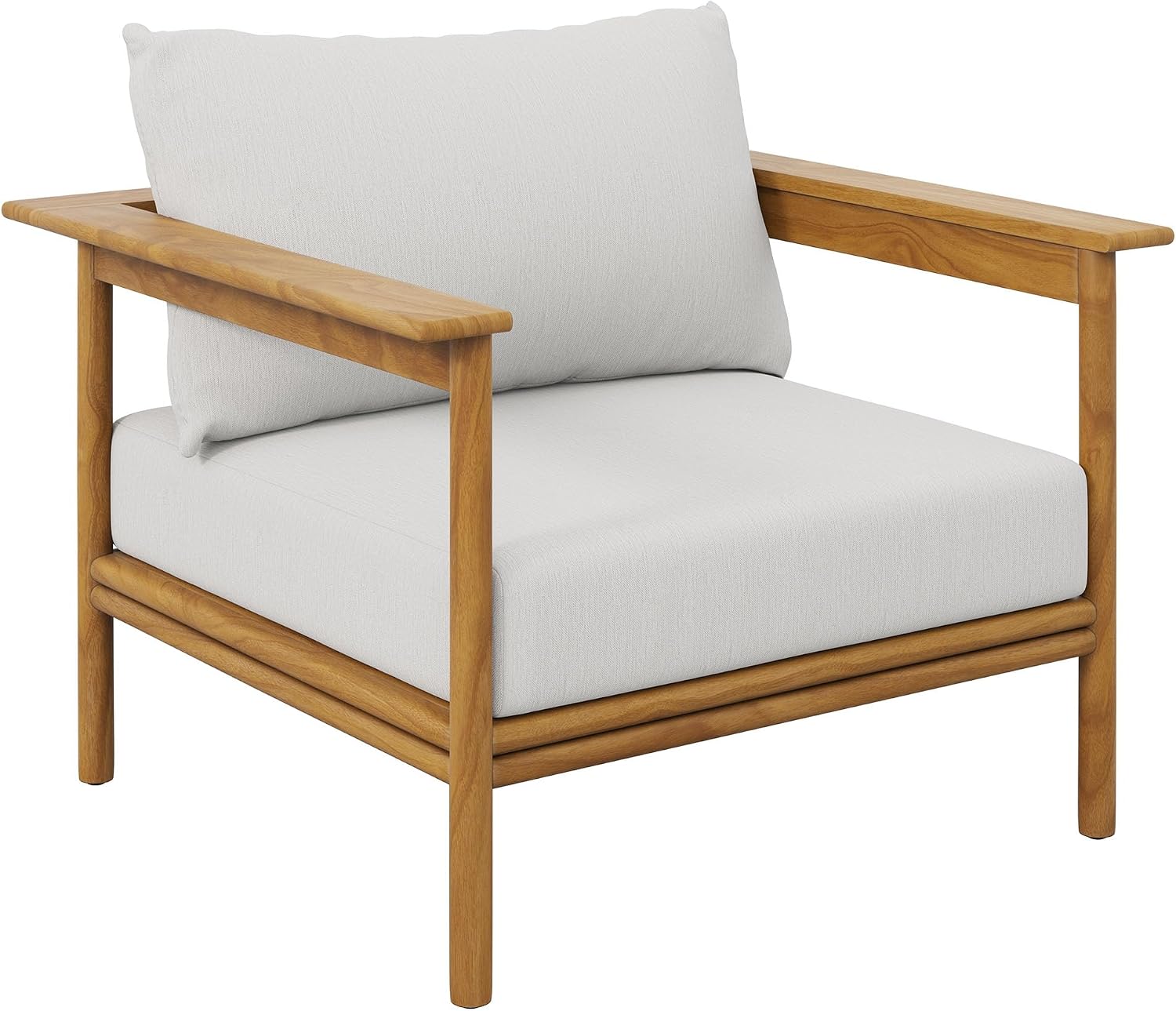
Modway
$1,474.19
In stock on Amazon
Check price on AmazonWhen Premium Grade A Teak Justifies the Price
Grade A teak’s price is defensible — and often the correct financial decision — in three specific conditions.
Coastal and high-humidity climates. In South Florida, the Gulf Coast, and Hawaii, the difference between acacia and teak isn’t aesthetic; it’s structural. Architectural Digest’s 2025 outdoor materials climate guide identifies salt air and humidity cycling as the primary accelerators of outdoor wood degradation, and acacia’s lower oil content makes it meaningfully more vulnerable. Owners in these zones consistently report checking, splitting, and joint failure in acacia sets within three to four seasons without aggressive maintenance — a maintenance burden that often exceeds the premium for teak once labor is priced honestly.
Permanent outdoor rooms where aesthetic coherence with interior architecture matters. When a landscape architect is specifying a resort-caliber residential renovation and the interior uses walnut millwork or white oak flooring, the warm honey-to-silver aging trajectory of Grade A teak reads as intentional and sophisticated. The visual consistency argument carries real weight in the luxury residential and boutique hospitality segment.
Buyers who won’t maintain wood. This sounds counterintuitive, but teak’s forgiveness is the most underrated argument for the premium. According to Sunset Magazine’s “Wood Outdoor Furniture Care Guide,” teak is the only common outdoor hardwood where skipping annual oiling is a deliberate, acceptable choice rather than a maintenance failure — the wood simply silvers without structural compromise. Acacia that goes unmaintained for two or three seasons begins to check and split. If you’re honest about your maintenance commitment, teak’s zero-intervention durability often wins the total-cost argument even at double the upfront price.
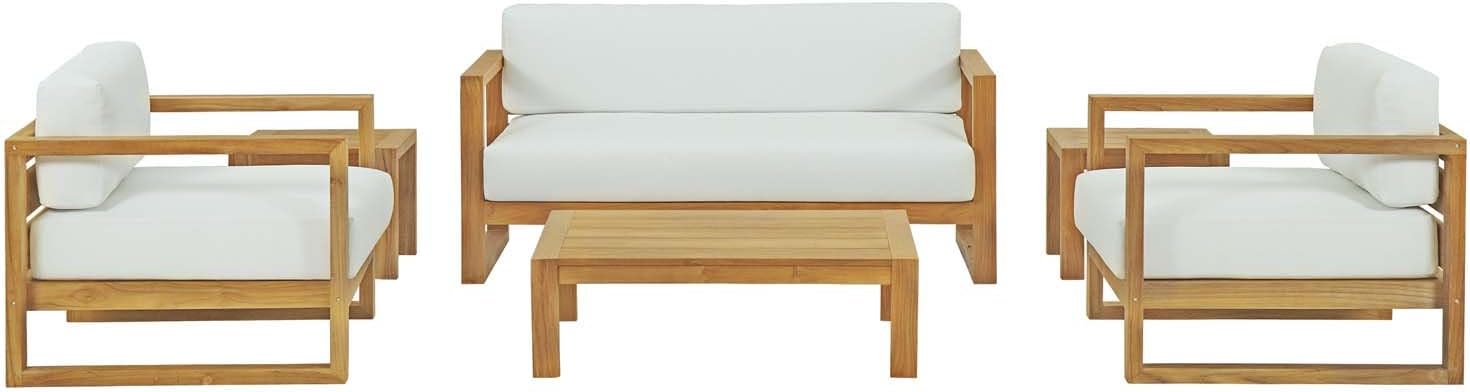
Modway
$1,959.65
In stock on Amazon
Check price on AmazonWarranty Clauses: What to Actually Read
Warranty language in outdoor wood furniture is where the most meaningful differences hide.
“Structural warranty” versus “finish warranty.” Nearly every brand at every price tier offers some structural warranty. The finish warranty — which covers the color, oil treatment, or surface coat — is usually shorter and more conditional. Good Housekeeping’s outdoor furniture review series notes that most acacia-based sets carry one-year finish warranties with language requiring annual treatment with a manufacturer-approved oil, meaning a missed oil cycle can void coverage. Read both documents before buying.
Grade A teak brands at the premium tier typically offer five-year structural warranties and explicitly state that natural silvering is not a warranty event. If a warranty says “natural weathering excluded,” that’s appropriate — the brand is covering joinery and structural failure, not the expected patina. Be cautious of any premium-priced teak set offering only a one-year structural warranty; that ceiling suggests either grade inconsistency in the raw material or limited confidence in the joinery.
FSC certification specificity. “FSC-certified wood” on a listing is less meaningful than “FSC Chain of Custody certification, Certificate Number [X].” The latter is auditable. The former may apply only to a single component of the set. This Old House’s 2024 hardwood sourcing guidance recommends treating any FSC claim without a verifiable certificate number as unconfirmed until documentation is produced. If sustainability provenance matters to your client or your own brief, ask the supplier for the chain-of-custody number before ordering.
The Decision Rule
Here it is, plainly stated.
If your climate is coastal or high-humidity, your maintenance commitment is low to moderate, or you’re specifying a permanent outdoor room intended to age gracefully alongside interior architecture — buy Grade A teak. The ten-year math closes within six years in these conditions, and the forgiveness of untreated teak is a real operational advantage.
If your climate is mild, your replacement cycle is five years or shorter, or you’re on a defined budget with an upgrade path already planned — solid acacia from a brand offering genuine FSC certification and a one-year structural warranty is a rational, honest choice. Budget for annual oiling and treat “teak-finish” listings skeptically until the underlying species is disclosed.
The middle of the market — teak-finish sets on acacia substrates priced at $1,200–$1,800 — is where the most value is lost. You’re paying a visual premium for teak’s color without the material properties that justify the cost. If a set is priced in that range and you can’t confirm solid Grade A teak construction, you’re almost always better served either dropping to a transparent acacia brand or stretching to the entry of the genuine-teak tier. The gap between “looks like teak” and “is teak” is the gap between a finish and a material — and outdoors, materials are what actually matter.