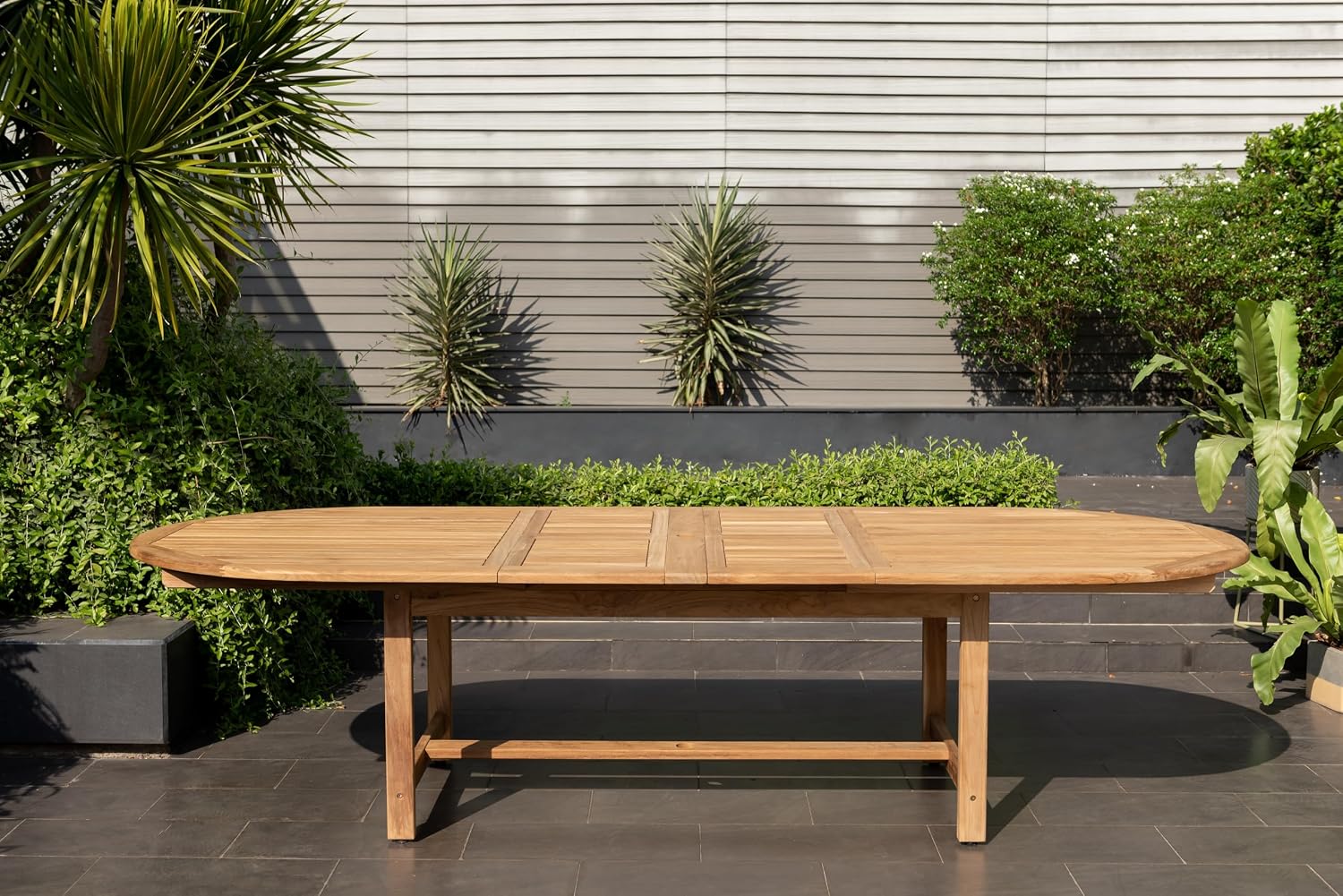
A teak extendable dining table is exactly what it sounds like: a solid-wood outdoor dining table — typically built from teak, one of the most weather-resistant hardwoods on earth — with a built-in mechanism that lets you pull or unfold the surface to seat more people. The “extendable” part is the tricky part. A fixed teak table is a solved problem; a teak table that expands reliably, levels cleanly, and doesn’t rack or warp after two seasons outdoors is a different engineering challenge. If you’re comparing options right now and wondering why two tables that look nearly identical at first glance differ by $1,500, this article will explain exactly what’s driving that gap — and help you decide whether the premium is worth it for your specific situation.
By the time you finish reading, you’ll know how to evaluate the three variables that actually determine whether an extendable teak table will still close smoothly in year five: the extension mechanism, the wood grade, and what the finish warranty covers (and what it quietly excludes).
| EDITOR'S PICK[Amazonia Fairview 9 Piece Teak](https://www.amazon.com/dp/B0D1RXTG5H?tag=greenflower20-20)… | Mid-tier[Amazonia Franklin 9-Piece Recta](https://www.amazon.com/dp/B0D1RXTG5H?tag=greenflower20-20)… | Budget pick[Christopher Knight Home Wilson](https://www.amazon.com/dp/B0GTZB239P?tag=greenflower20-20)… | |
|---|---|---|---|
| Material | Teak | Teak | Acacia Wood |
| Extension Type | Double Extendable | Extendable | Expandable |
| Table Shape | Oval | Rectangular | — |
| Set Size | 9-Piece | 9-Piece | — |
| Finish | — | Teak Finish | Teak Finish |
| Price | $2,367.00 | $1,399.00 | $419.99 |
| See on Amazon → | See on Amazon → | See on Amazon → |
Extension Mechanisms: The Part That Actually Fails
The table’s frame and top get all the marketing attention. The mechanism gets almost none — until it sticks, binds, or develops a half-inch gap at the seam after one winter. There are four mechanism types worth knowing:
Butterfly (self-storing) leaf. The leaf folds in half and stores under the tabletop, concealed inside the apron frame. To extend, you pull the two halves of the top apart and the butterfly leaf unfolds to fill the center gap. The appeal is obvious — you never hunt for a stored leaf. The limitation outdoors is that the folded leaf lives in a humid, shaded cavity that traps moisture and can cause differential swelling. Brands like Gloster and Brown Jordan use precision-machined aluminum tracking channels to manage this, but entry-level butterfly mechanisms made with steel slides in a teak frame frequently seize after one humid season. This Old House’s outdoor furniture guidance notes that mechanism corrosion is among the most common service complaints in humid-climate furniture returns.
Slide-and-lock (track extension). The two tabletop halves slide apart on steel or aluminum tracks; a separate leaf — stored elsewhere — drops into the center gap. This is mechanically simpler and easier to service. The tradeoff is that you’re storing a leaf in a shed, garage, or bag. For permanent outdoor living rooms where the table stays set most of the time, this is less annoying than it sounds. The quality signal to look for: marine-grade stainless or anodized aluminum tracks, not painted steel. On the production-quality end, Janus et Cie and Barlow Tyrie both specify anodized aluminum runners on their extendable collections. Owners in long-run reviews consistently report that track quality — not the wood — determines whether year-three extension feels effortless or requires two people.
Drop-in leaf (no mechanism). Some tables marketed as “extendable” are simply fixed tables with a matching separate leaf that rests on support brackets. There’s no sliding hardware. The seam alignment depends entirely on manufacturing tolerances; if the top moves at all over time, the leaf will sit proud or low. This is fine for occasional indoor use. Outdoors, it’s the first mechanism to reject — teak moves seasonally with humidity, and without precision guides, the seam gap will open. Architectural Digest’s design-expert roundup on outdoor dining tables specifically flags seam consistency as a distinguishing marker between entry-level and investment-tier extendable tables.
Pedestal vs. leg-frame extension geometry. Separate from the mechanism itself: pedestal-base tables extend more cleanly than four-leg tables because you don’t run into leg-positioning problems at full extension. A 78-inch four-leg table that extends to 102 inches often leaves guests straddling an apron leg. Pedestal designs — particularly the single- or double-pedestal trestle format favored by Gloster’s Kore collection and similar offerings — keep leg clearance consistent across all lengths. If you’re planning to regularly use full extension, pedestal geometry is worth paying for.
Wood Grade: Why “Teak” Alone Tells You Very Little
Teak is a species (Tectona grandis), not a quality standard. The grade of cut, the plantation origin, and the part of the log used all affect how the table will perform outdoors over a decade. Good Housekeeping’s teak outdoor furniture review notes that grade terminology is one of the most inconsistently applied labels in the outdoor furniture category — a finding echoed by nearly every comparative review in the premium-to-mid-market space.
The three grades that matter for buyers:
Grade A (heartwood). Cut from the mature center of the log, where teak’s natural oils — the ones that make it weather- and insect-resistant — are most concentrated. Color is consistent golden-brown. Grain is tighter. This is the grade used by Barlow Tyrie, Gloster, and Brown Jordan in their premium teak collections. It’s the grade worth specifying if you’re buying furniture meant to last 20+ years.
Grade B (mixed heartwood/sapwood). Cut from zones closer to the outer log. Oil content is lower; the wood may include some sapwood (the lighter, outer growth ring). More variation in color and grain. Not necessarily a short-life table — with regular oiling, Grade B teak can perform well — but it’s maintenance-sensitive in a way Grade A is not. Dwell’s buyer overview on teak outdoor furniture notes that mid-market brands sometimes use Grade B cuts and compensate with heavier finishing, which is a reasonable tradeoff at lower price points but changes your long-run maintenance commitment.
FSC certification and plantation origin. Legally harvested teak from FSC-certified (Forest Stewardship Council — an independent certification that wood comes from responsibly managed forests) Indonesian or Myanmar plantations is the responsible sourcing standard. Most premium brands — Gloster, Barlow Tyrie, Kingsley Bate — publish their FSC certification numbers. If a brand won’t specify origin or certification, that’s a meaningful data gap. Plantation teak at Grade A is sustainable and performs comparably to old-growth; the oil content difference is minor when the cut is from mature heartwood.
By the numbers:
| Grade | Oil Content | Typical Warranty | Re-oiling Interval |
|---|---|---|---|
| Grade A heartwood | High | 5–10 yr frame | 1–2 years (or leave to silver) |
| Grade B mixed | Moderate | 2–5 yr frame | Annually |
| Ungraded / sapwood | Low | Often none stated | Seasonally |
Finish Warranties: What “Covered” Actually Means Outdoors
This is where you need to read the fine print rather than the headline. Most premium teak tables are sold with two distinct warranty categories that are easy to conflate: the frame/structural warranty and the finish warranty. They are governed by completely different terms.
Frame warranties on investment-tier teak (Gloster, Janus et Cie, Barlow Tyrie) typically run five to ten years against structural defects — cracking through the frame, joint failure, or delamination. These are generally reliable and honored. The fine print to check: does “cracking” include surface checking (the shallow, cosmetic cracks that form as teak dries and moves) or only through-cracks that compromise structure? Many warranties explicitly exclude surface checking, which can look alarming but is a normal feature of teak’s seasonal movement, not a defect.
Finish warranties are narrower. Teak is almost always sold in one of three finish states: raw/unfinished (meant to silver naturally to gray), oiled (treated with teak oil to maintain the warm honey color), or a factory-applied boat-grade sealant. Raw and oiled tables are rarely covered for finish changes — silvering is expected behavior, not damage. Factory-sealed tables may carry a one- to two-year finish warranty, but the conditions that void it (standing water pooling on the surface, exposure to pool chemicals, improper cleaning products) are broad enough that claims are frequently rejected. Architectural Digest’s design expert coverage notes that finish warranty claims on outdoor teak are among the more commonly disputed service cases in the category.
What a “lifetime” warranty usually covers: the aluminum or stainless subframe components (if present), weld integrity, and sometimes the mechanism tracks. It does not cover the wood surface, cushion fabric, or the mechanism’s sliding action under heavy use. Per Good Housekeeping’s findings in their long-form teak review, the strongest warranties in the category — Gloster’s and Barlow Tyrie’s — are notable specifically because they cover the mechanism hardware separately from the frame, with explicit exclusions that are plainly listed rather than buried.
The question worth asking your dealer directly: “If the extension mechanism binds or the track corrodes in year three, is that covered, replaced, or serviced at cost?” The answer tells you more than the warranty card.
The If/Then Decision Framework
You’re at the point of decision. Here’s how to map the options:
If your table will stay outdoors year-round in a humid or coastal climate — the Gulf Coast, Pacific Northwest, or any environment with significant humidity swing — prioritize the mechanism above everything else. Marine-grade aluminum tracks in a pedestal-base configuration, from a brand that publishes mechanism service availability (Barlow Tyrie, Gloster). Grade A heartwood with no factory finish (let it silver; zero maintenance risk). Budget: $3,500–$8,000+.
If you’re furnishing a vacation rental or multi-unit property where guests will operate the extension mechanism repeatedly with zero training — choose a slide-and-lock table with the simplest possible mechanism over a butterfly-leaf design. Simpler mechanisms tolerate abuse better and are field-serviceable. Brands like Kingsley Bate offer extendable teak at the $2,500–$4,500 range with robust track hardware and documented service parts availability.
If you’re in a four-season climate where the table comes inside or under cover for winter — you have more flexibility on grade. Grade B teak with annual oiling performs reliably in this use pattern. The mechanism still matters; a butterfly leaf that winters in a heated garage will expand more uniformly than one left outdoors. In this scenario, mid-market brands at $1,800–$3,000 (think Amazonia or TeakCraft-tier production) can offer real value if the mechanism hardware is steel-track rather than nylon.
If the table’s fixed dimensions work 85% of the time and you’d use extension fewer than six times per year — consider a fixed teak table and a matching freestanding accent piece for overflow, rather than paying the mechanism premium. Extendable tables trade structural simplicity for flexibility; if you don’t need the flexibility often, you’re paying for complexity that can fail.
The core rule: spend the mechanism money before you spend the grade money. A Grade A teak table with a corroding steel butterfly mechanism will frustrate you. A Grade B teak table on anodized aluminum tracks that extends cleanly for fifteen years will not.
Sources referenced in this article: This Old House, outdoor furniture selection guides; Architectural Digest, outdoor dining table design-expert roundups; Good Housekeeping, teak outdoor furniture reviews and warranty analysis; Dwell, teak outdoor furniture buyer overview; Forest Stewardship Council, chain-of-custody certification documentation for teak sourcing.